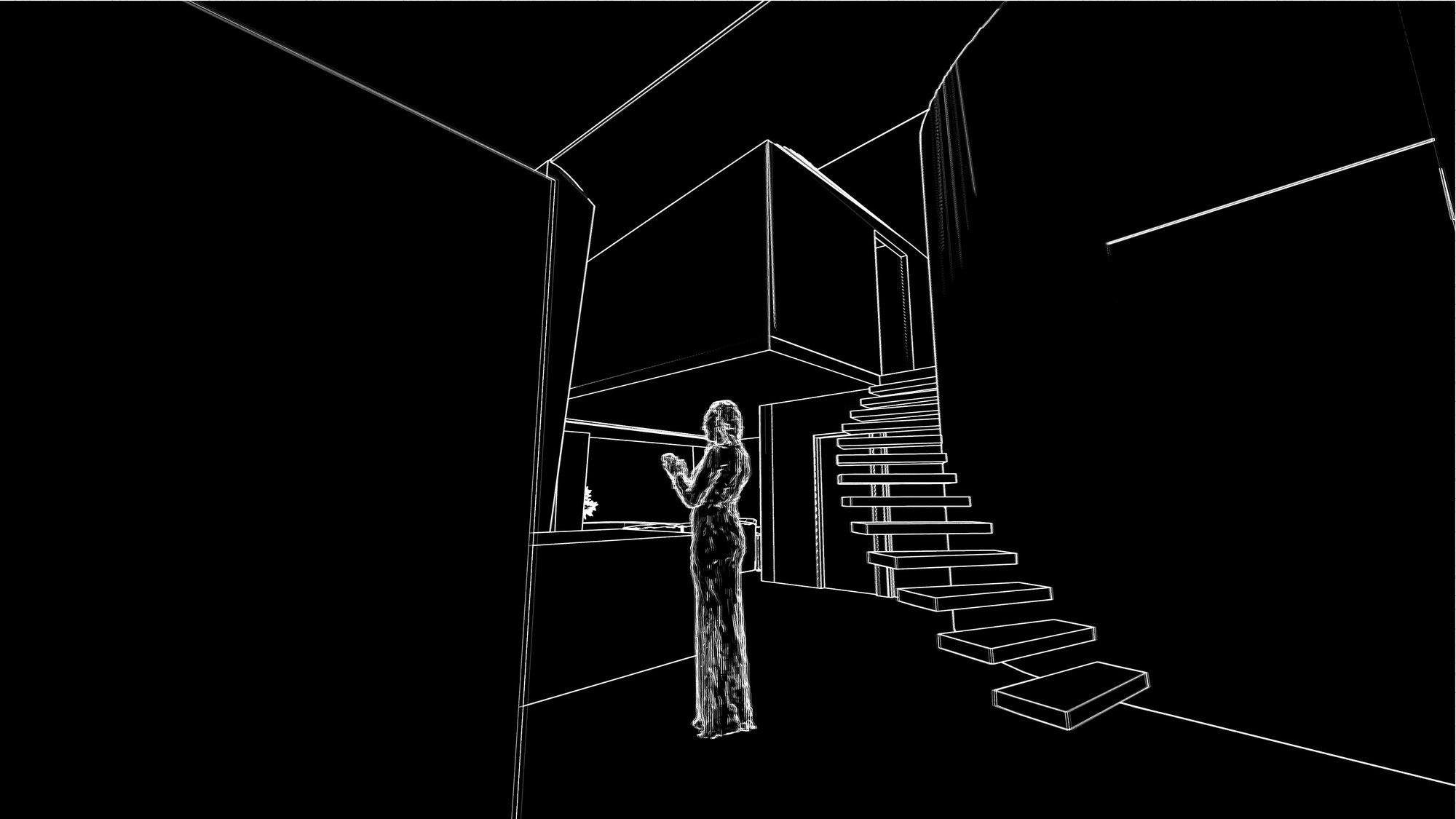
Essay · Lake Road Wildernis
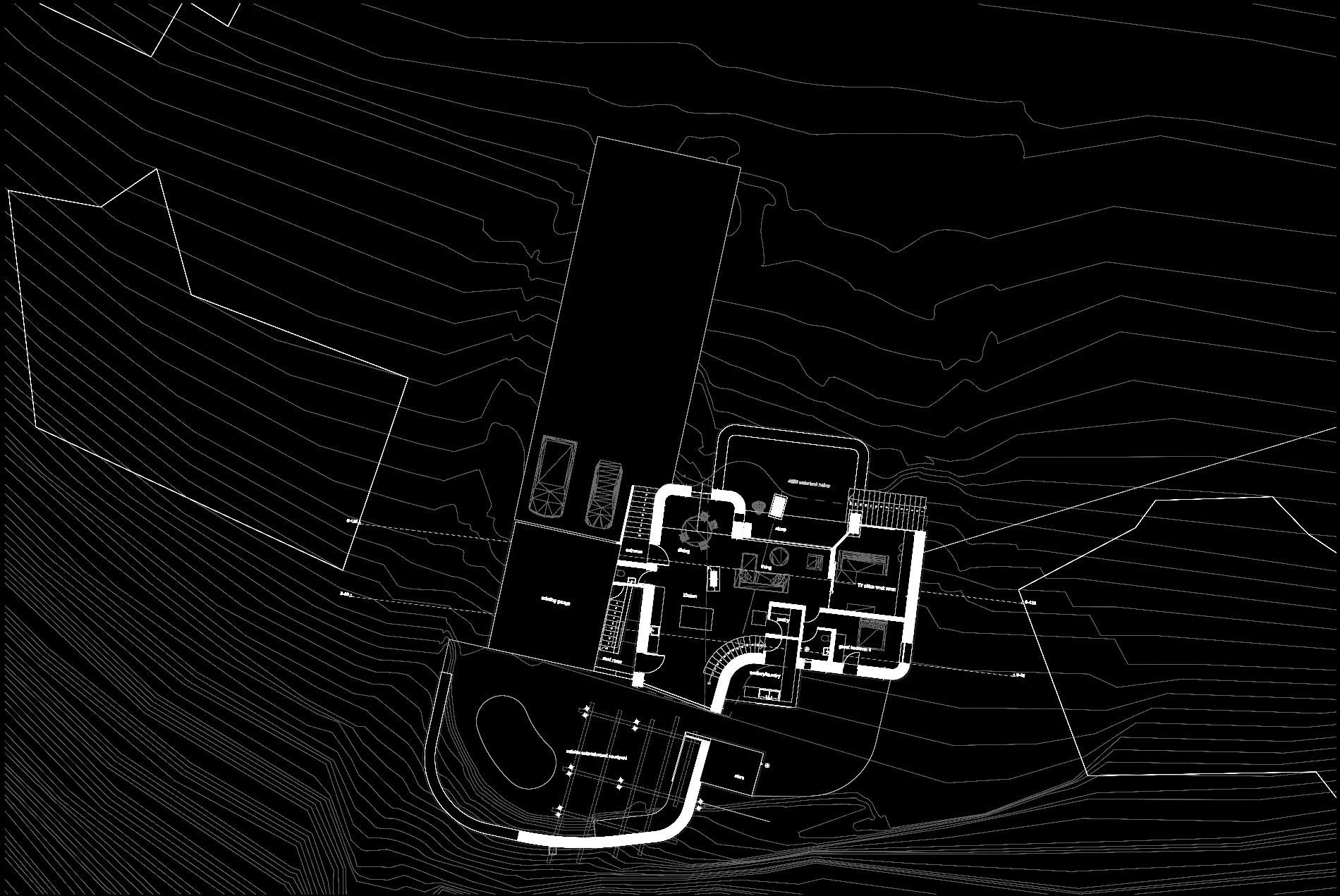
Regulation, lineage and argument for a three-thousand-year-old technique: stone plums cast in a lean matrix of pit-run gravel and cement, one metre at a time. Written for the Lake Road Wildernis project, where 600 mm cyclopean walls rise to 6.5 m inside a reinforced-concrete carcass.
South African building law never defines concrete as a substance. It defines it as a performance. The National Building Regulations state functional requirements — a wall shall safely sustain its loads — and SANS 10400 offers three ways to prove that: the deemed-to-satisfy rules, a rational design by a competent person, or an Agrément certificate. The recipe is never the law; the proof is.
SANS 2001-CC1 (Concrete works, structural) defines concrete by grade — the characteristic 28-day cube strength — not by cement content. And clause 4.2.3 already permits cyclopean concrete under the name plum concrete: in plain concrete at least 300 mm thick, stone plums of 15–55 kg may displace up to 20% of the volume, provided no plum exceeds one-third of the smallest dimension of the element. In a 600 mm wall that ceiling is 200 mm. This is not an exotic alternative technique — it is standard South African concrete, already written into the national specification.
The real weak point is the matrix, not the stone. G10 road subbase carries fines and an all-in grading that SANS 1083 concrete aggregate excludes, so strictly it can never be code-concrete at any cement content — what it is, in road-engineering language, is a cemented natural gravel: roughly 2% cement for a C4-grade 0.75–1.5 MPa matrix, 4% for C3-grade 1.5–3 MPa. And the whole question mostly dissolves in practice: a monolithic cast wall 6.5 m tall inside an RC frame sits outside every prescriptive part of SANS 10400 regardless of material, and lands automatically in rational-design territory — an appointed competent person (structures) tests and specifies the matrix directly, and the municipality never adjudicates the recipe.
At Lake Road, cyclopean fill at ±2,300 kg/m³ stacked 6.5 m gives a base self-weight stress of roughly 0.15 MPa — under 0.3 MPa loaded. Even a lean C3-grade matrix at 1.5 MPa carries that with a factor of five. Slenderness is a non-issue: 3,000 mm free height over 600 mm thickness (h/t = 5) sits far inside where the masonry deemed-to-satisfy rules operate near h/t = 20.
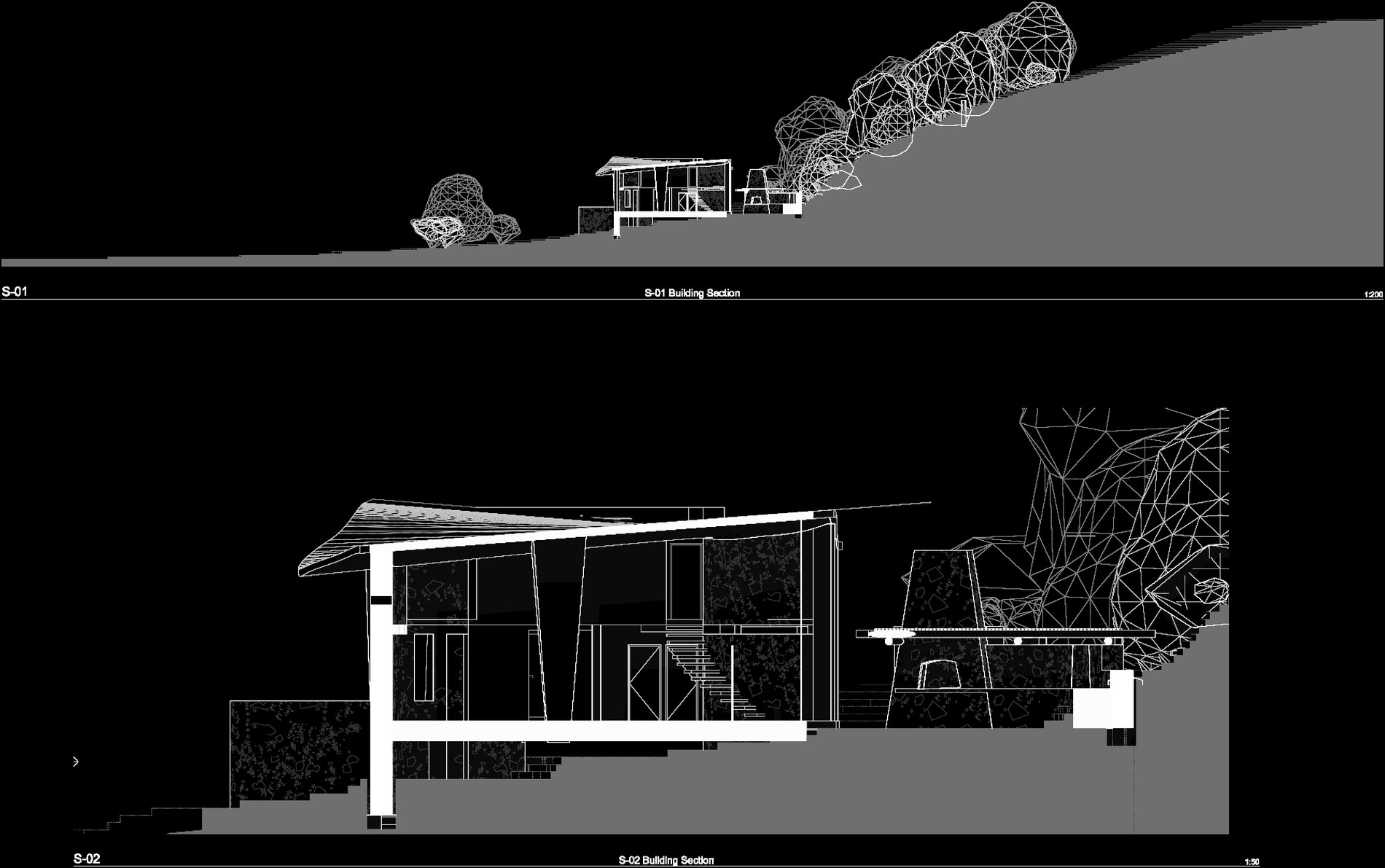
South Africa is unusual in neither direction. Peru's national code, NTE E.060, defines concreto ciclópeo directly: matrix f'c = 100 kg/cm² (≈10 MPa), up to 30% displacer stone, and — the detail that matters here — its aggregate, hormigón, means pit-run all-in sand and gravel, unwashed and ungraded. Ministry self-build manuals specify strip foundations at cement:hormigón 1:10 + 30% large stone. Peru codifies, at national level, almost exactly the Lake Road mix.
New Zealand is the benchmark for the adjacent question — monolithic earth. NZS 4297, 4298 and 4299 (1998, revised 2020 and 2024, now free to download) cover adobe, rammed earth and poured earth as cited Building Code compliance paths, with a full test regime rather than a ban on variability. NZS 4297 caps earth walls at 6.5 m from footing to wall top — precisely the Lake Road number.
Britain's old plum-concrete clauses survive as permissive fossils rather than living practice — SANS 2001-CC1's 20% plum allowance is the South African descendant; the United States built entire dams this way (Pathfinder Dam, Wyoming, 1909) before roller-compacted concrete replaced it. South Africa, with one of the world's great vernacular earth traditions, offers no equivalent earth-building standard at all — only a 2023 eco-label that defers back to rational design.
| Jurisdiction | Cyclopean concrete | Monolithic earth / stabilised gravel |
| South Africa | Permitted as plum concrete (SANS 2001-CC1 cl.4.2.3, 20% plums); otherwise rational design | No standard, no Agrément system certificate; rational design only; ecoASA eco-label 2023 |
| Peru / Andes | Fully codified (E.060): matrix 10 MPa, 30% stone, pit-run aggregate lawful | Adobe fully codified (E.080), incl. seismic provisions |
| New Zealand | Via generic concrete / design standards | Full suite NZS 4297/98/99 (2024), free issue; 6.5 m height cap; 0.5 MPa standard grade |
| Zimbabwe | Via concrete standards | SAZS 724:2001 — first African national rammed-earth code |
| Germany / EU | Legal via EN 1992-1-1 §12 (plain concrete); technique unnamed | DIN 18945–47 + Lehmbau Regeln |
| USA | Historic dam practice (Pathfinder 1909); ACI mass-concrete custom | IRC App. AU (cob); New Mexico earthen code |
| India | Plum concrete live in dams, retaining walls, foundations | CSEB and soil-cement IS standards |
The honest concession first. A standard exists to make trust portable — SANS 1083 strips aggregate of everything local and unknowable so a cube in Kakamas means the same as one in Sandton. Cyclopean concrete from pit-run G10 deliberately violates that premise. The committee that hesitates is defending an epistemology, not merely protecting a cement lobby — though the record on Agrément's rejection rate for earth systems suggests it is not innocent either.
The performance argument. Regulation B1 does not ask what a wall is made of; it asks whether it safely does its work. A 600 mm cyclopean panel confined in an RC carcass, working at 3% of even a lean matrix's capacity, satisfies B1 by an embarrassing margin. Where the material is variable, the answer is testing, not prohibition — trial panels, cubes per batch source, a durability brushing test — exactly how New Zealand domesticated earth.
The geographic argument. Requiring washed, graded, crushed aggregate is a logistics judgement dressed as a safety judgement — it taxes remoteness and, in effect, outlaws the ground people stand on. Peru's code shows the alternative is not chaos: pit-run hormigón is a lawful national material with a century of housing stock behind it. And the carbon arithmetic agrees — a wall that needs 0.3 MPa and is forced by classification to 15 MPa emits roughly four times the cement it needs.
The cultural argument. Concrete did not begin as a graded industrial product. Roman opus caementicium — rubble drowned in mortar — is cyclopean concrete; the Pantheon's dome is a plum wall folded over its own head. The plum clause in SANS 2001-CC1 is the standard's own memory of what concrete was for two thousand of its two thousand two hundred years. To name and test the technique properly is not innovation. It is the standard remembering itself.
A note on a visual cousin that is not a technique cousin: Valerio Olgiati's Das Gelbe Haus (Flims, Switzerland, 1999) reads, in photographs, as cyclopean concrete — rough, irregular stone under a uniform white limewash, close in surface character to the Riverside finish above. It is not. Olgiati's own account is explicit: the walls are the farmhouse's existing stone masonry, exposed by stripping away later plaster and then hammer-worked by hand for texture; new concrete appears only as small cast-in-situ window reveals. The operation is subtraction, not casting — worth naming precisely because it separates two questions the eye tends to merge: the rough-stone-under-limewash aesthetic, achievable by exposing old masonry, and the load-bearing plum-in-matrix technique, achievable only by casting. Lake Road does both at once — which is the rarer and more difficult thing.
The bureaucrat's summary, for Lake Road: nothing needs to change. Specify the wall as plain (plum) concrete under SANS 2001-CC1 with project specification data written by the appointed competent person (structures); prove the G10 matrix by trial panel and cube; lodge the Form 2.
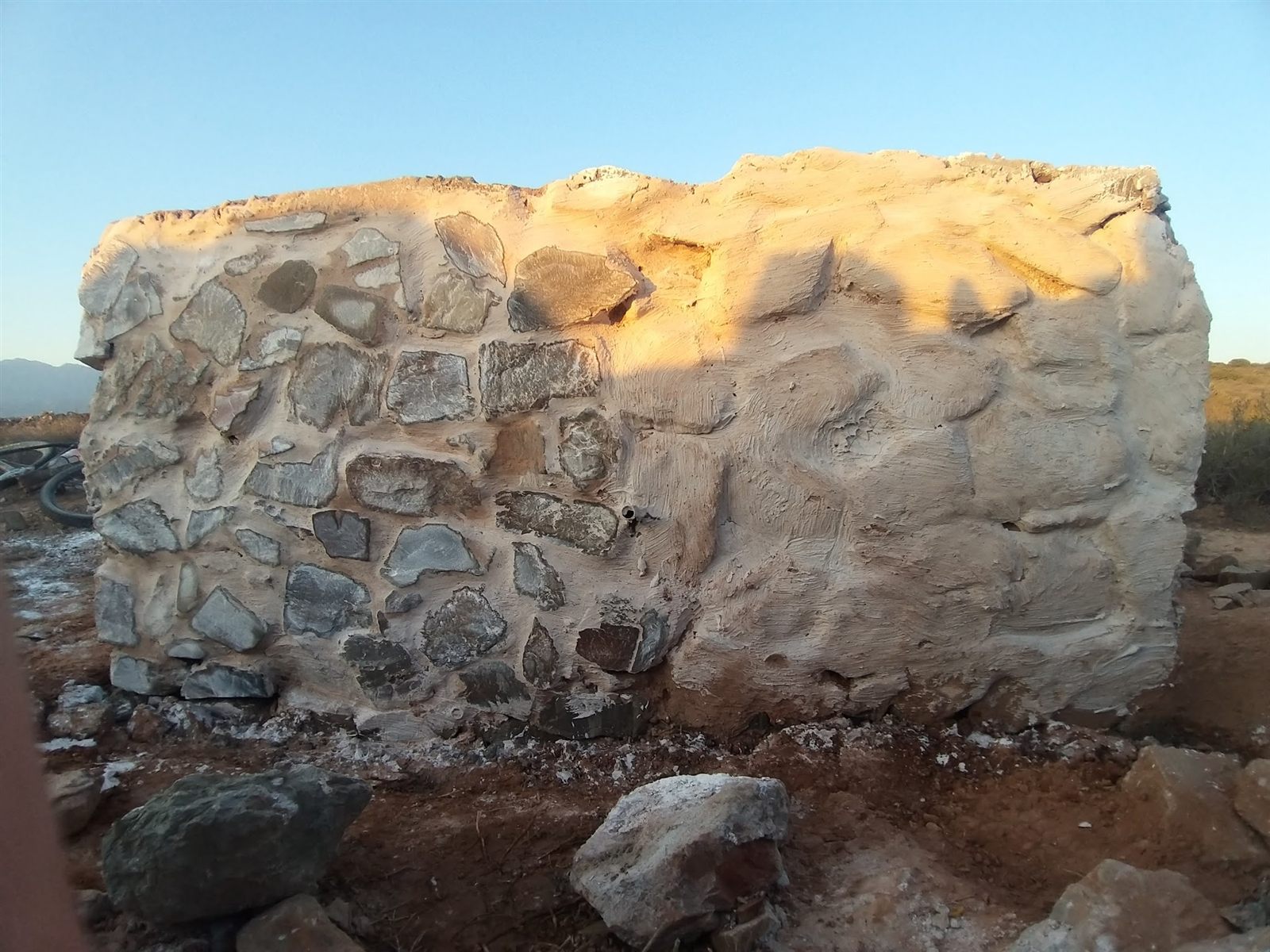
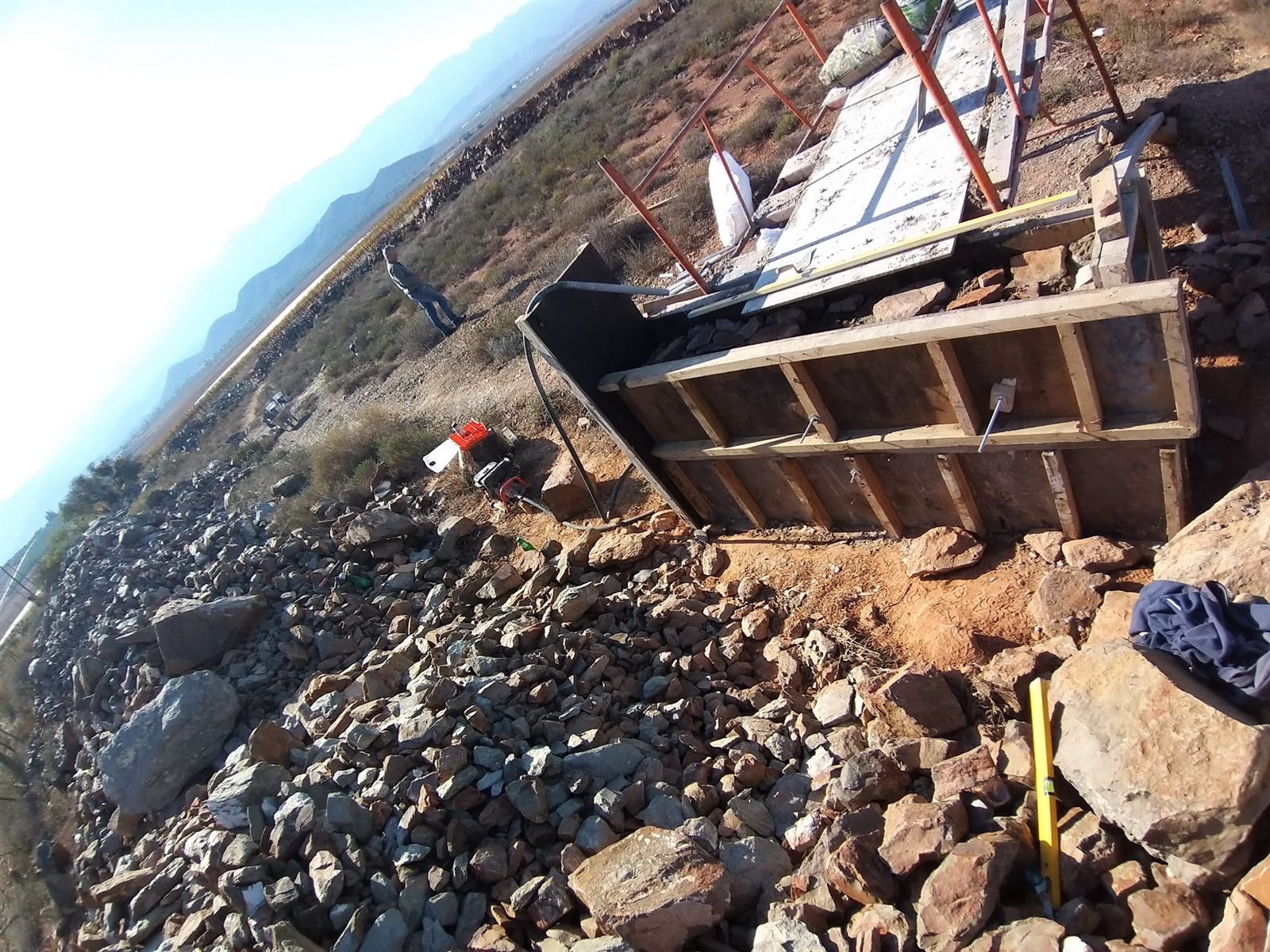
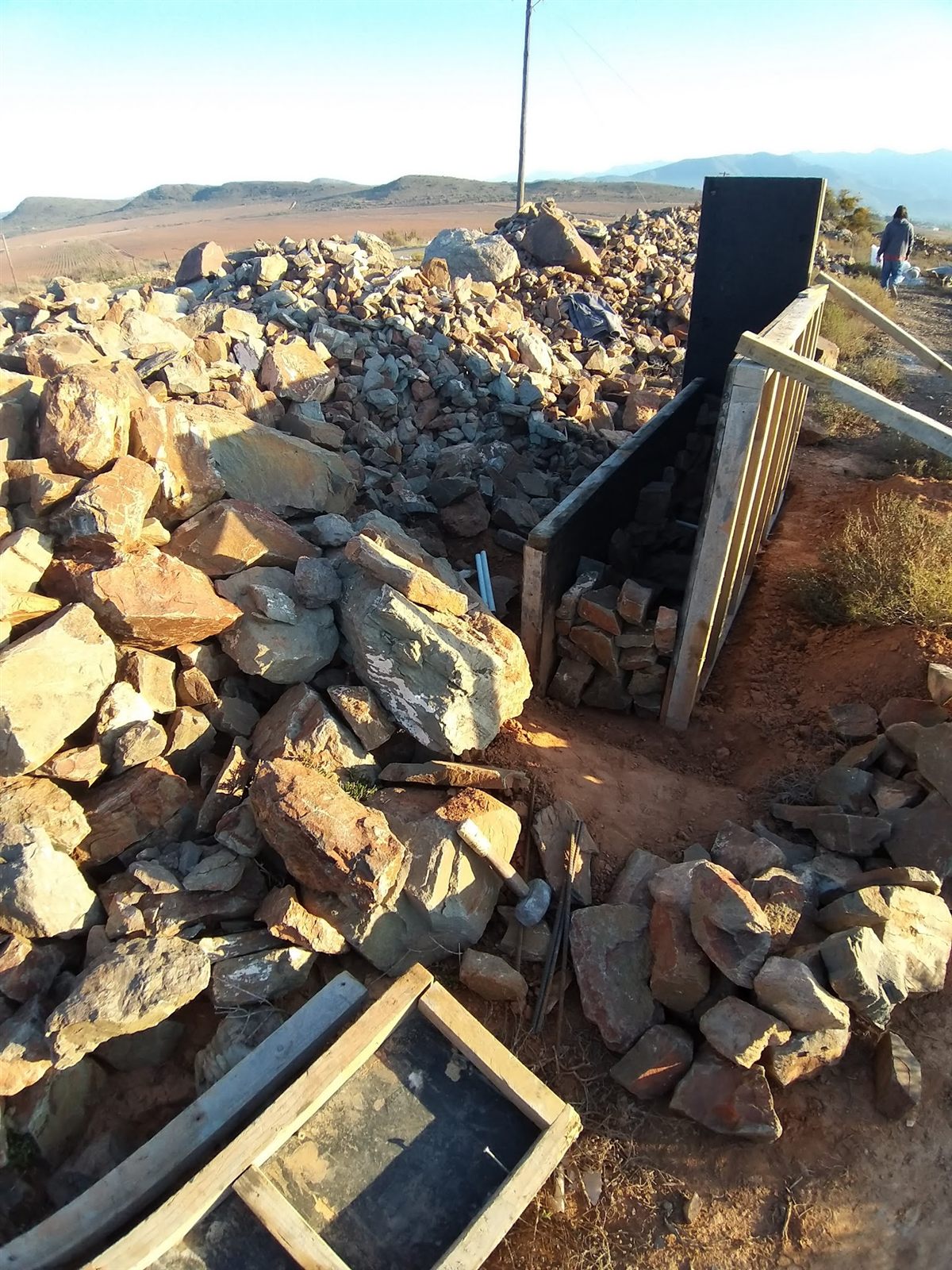
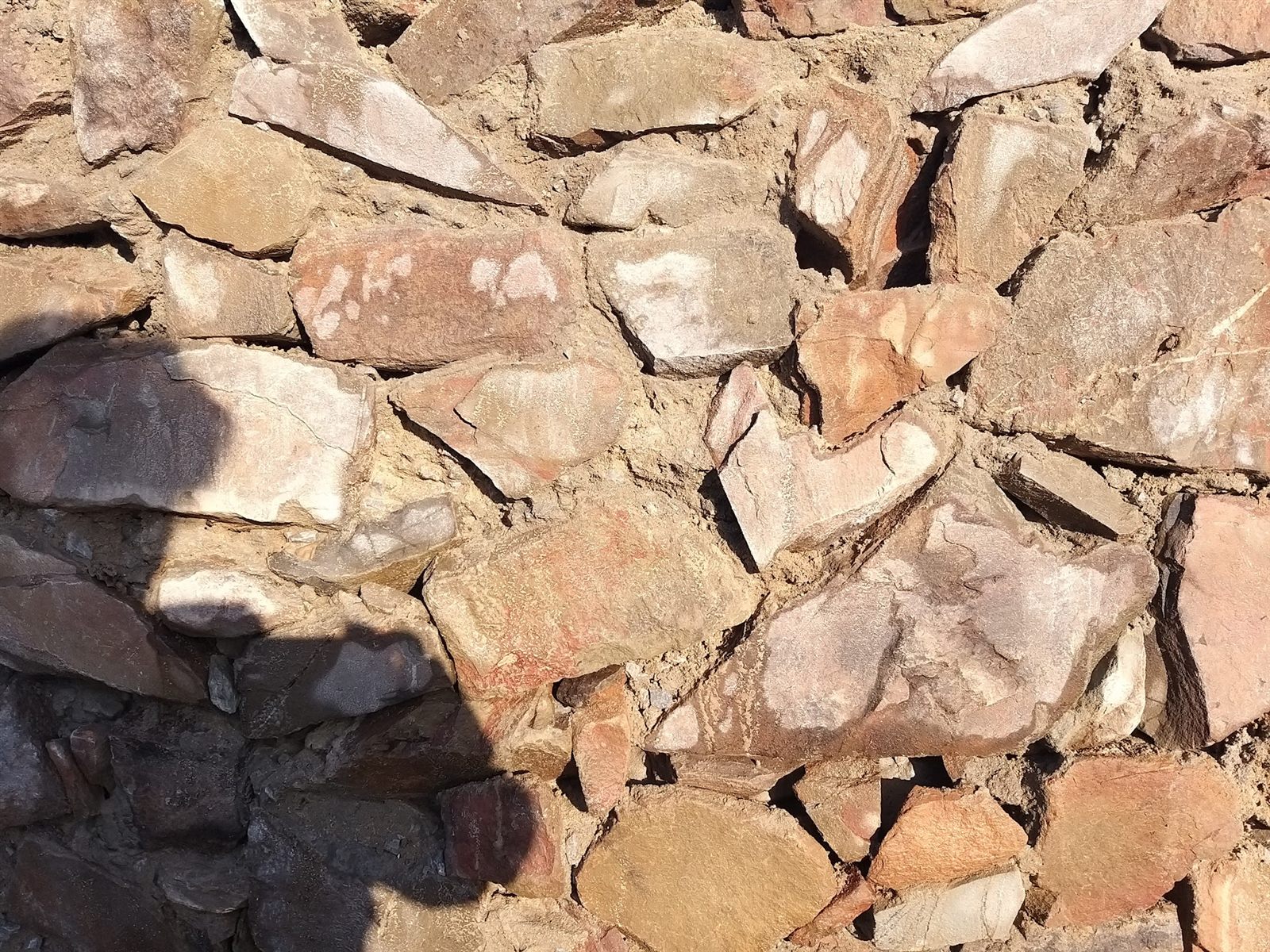
Everything argued above was tested before it was written. In 2022 a sample cyclopean wall was built at Riverside by this practice — stone packed by hand inside standard 1220×2440 mm shutter-board formwork, concrete poured and vibrated over it in layers of 200–300 mm with a petrol poker, smaller stones added continuously through the pour. The first pour was batched too wet — the poker drove the matrix straight through the packed stone and out of the shutter joints. Correcting the aggregate size and water content fixed it, and the failure was itself the most valuable result: it proved the matrix migrates fully through the stone skeleton under vibration, filling the wall solid and, in the builder's own observation, making it watertight.
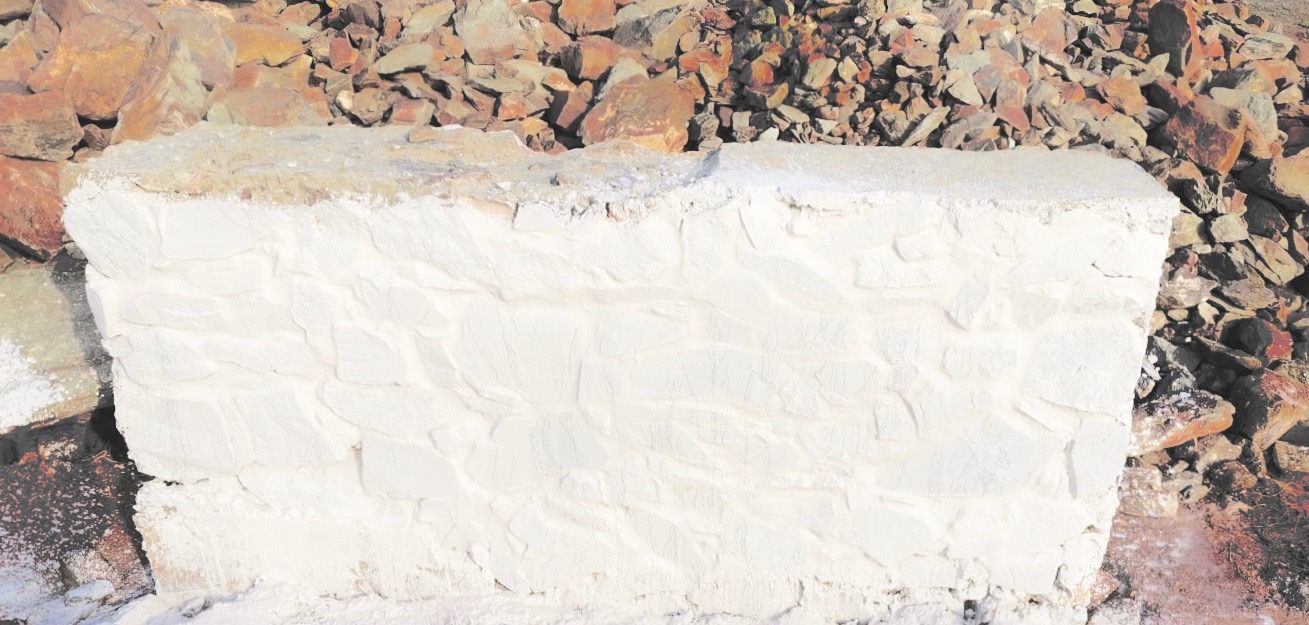
The joints wanted lime, not cement — the larger voids were pointed by hand in lime plaster, visibly finer than grey cement. The selected external finish is flush-struck, lime-pointed joints under a white limewash, deliberately in the lineage of Cape regional architecture — per the Vernacular Architecture Society of South Africa's record of stone building in the Swellendam district, and Gawie Fagan's observation that the plastic quality of softly plastered, limewashed walls is the most unifying characteristic of the Cape tradition.
As built, the Riverside wall is closer to grouted rubble — well above the 20% plum ceiling of SANS 2001-CC1 — than to code-defined plum concrete, and the Lake Road specification must describe it as what it is. The 200–300 mm pour-and-vibrate layer is the tested increment within each 1 m shutter lift.
Ensamble Studio's own Cyclopean House (Brookline, 2015) is excluded on principle — its "boulders" are foam-cored ultralight prefabrication, the inverse of the technique. Photographs below are not reproduced here; each work links directly to its original gallery.
Strictly, ancient "cyclopean concrete" does not exist — cyclopean names dry masonry; concrete arrives only with Rome. This list traces both bloodlines that merge in the modern technique.
SABS. SANS 10400-A/B/K — The application of the National Building Regulations. SABS Standards Division, Pretoria.
SABS. SANS 2001-CC1 — Construction works Part CC1: Concrete works (structural), cl. 4.2.3 (stone plums).
Agrément South Africa. ecoASA Specification for Rammed Earth Construction, ASA 21i/01/2023.
Ministerio de Vivienda, Construcción y Saneamiento (Perú). Norma Técnica E.060 — Concreto Armado.
Standards New Zealand. NZS 4297 / 4298 / 4299 — Earth buildings (1998; rev. 2020; rev. 2024).
Standards Association of Zimbabwe. SAZS 724:2001 — Rammed Earth Structures.
Vernacular Architecture Society of South Africa (VASSA). Journal No. 14, December 2005 (ed. A. Malan).
Fagan, G. (1983) — on the plastic quality of softly plastered, limewashed Cape walls; see also Die Es, Camps Bay.
Booyens, J. (2022). Riverside Klipmuurtjie — trial-wall construction record, Jaco Booyens Architect.
Olgiati, V. (1999). Das Gelbe Haus, Flims — project text on the renovation of an existing stone farmhouse; cited via Archiweb.cz and e-architect.com as evidence the technique is exposed masonry, not cast concrete.
Adam, J.-P. (1994). Roman Building: Materials and Techniques. Routledge, London.
Lancaster, L.C. (2005). Concrete Vaulted Construction in Imperial Rome. Cambridge University Press.
Brandon, Hohlfelder, Jackson & Oleson (2014). Building for Eternity. Oxbow Books, Oxford.
Maiztegui, B. (2021). Cyclopean Concrete and Its Many Diverse Uses and Applications in Architecture. ArchDaily.
A downloadable PDF of this essay, with the same content and full citation list, is available on request.